Showing posts with label Beyoglu. Show all posts

Friday, July 2, 2021

BEYOGLU, ISTANBUL

  THE EUROPEAN "NEW TOWN" ACROSS THE GOLDEN HORN


Beyoglu is a brief and magical ferry ride across the Golden Horn from the old city’s Eminonu docks to Karakoy.

The waterfront area follows the Golden Horn to its mouth off the Bosphorus.

Dozens of street vendors set up, serving tea, coffee, snacks…or playing solo or in a band – to earn the tips of locals and visitors.

Thursday, July 1, 2021

BEYOGLU, ISTANBUL

  THE EUROPEAN "NEW TOWN" ACROSS THE GOLDEN HORN


Karakoy is a former docklands area that was far off the tourist path and somewhat sketchy.

Now it is lined with pricey hipster joints open late each night.

There are lots of nargile joints in this part of Beyoglu.

The food can range from modern gourmet burgers to old time Turkish street food such as kumpir.

Wednesday, June 30, 2021

BEYOGLU, ISTANBUL

  THE EUROPEAN "NEW TOWN" ACROSS THE GOLDEN HORN


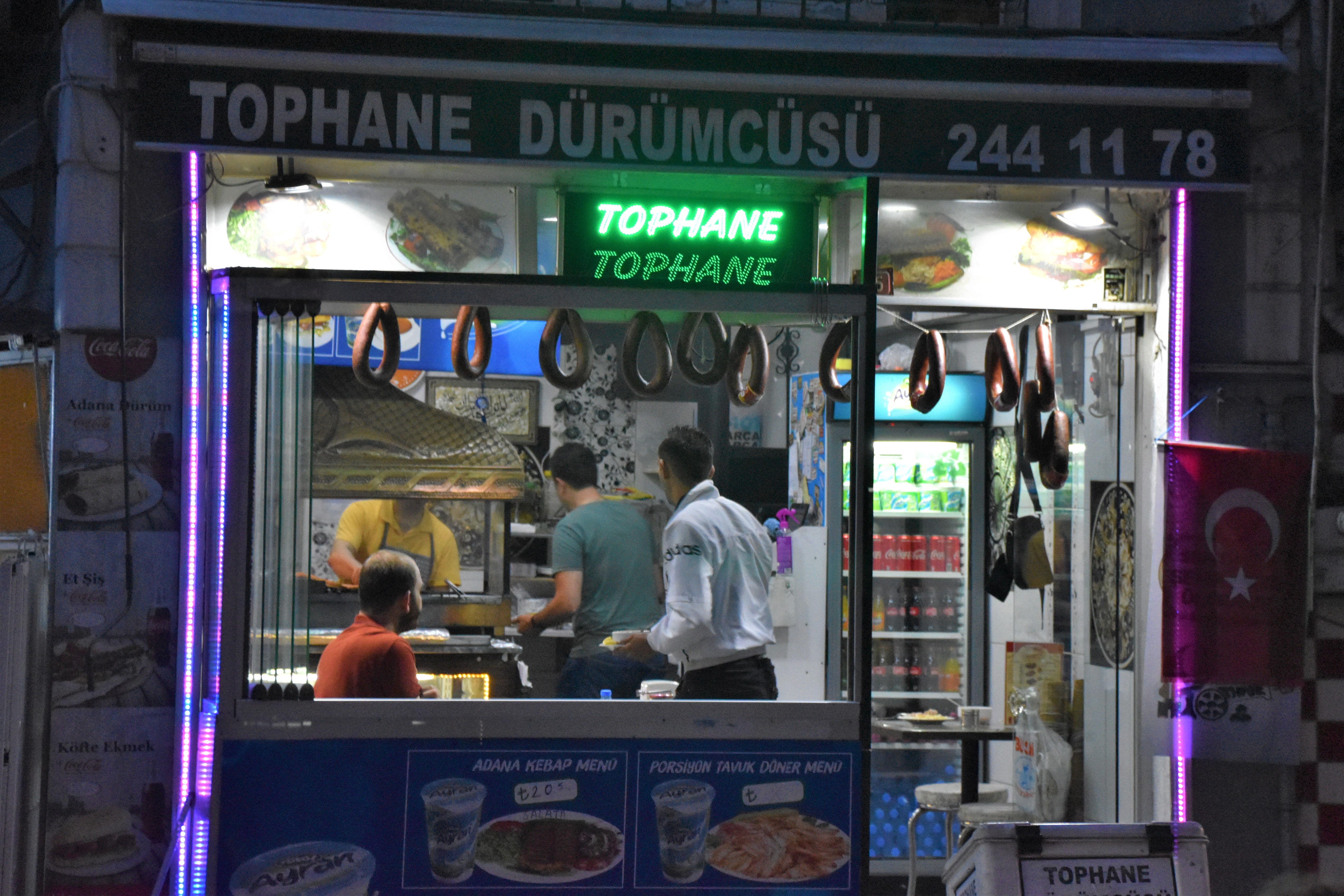
A durum is a Turkish wrap that is usually filled with typical doner kebab ingredients.

This place, open since 1969, specializes in chicken, lamb and adana.

The wrap is made from lavash or yufka flatbreads.

Durum is a common street food in Turkey, especially beloved late at night.

Tuesday, June 29, 2021

BEYOGLU, ISTANBUL

  THE EUROPEAN "NEW TOWN" ACROSS THE GOLDEN HORN


While more than a few churches have been converted into mosques in Islamic Turkey, cathedrals, synagogues and churches – orthodox and modern, do remain.

Monday, June 28, 2021

BEYOGLU, ISTANBUL

  THE EUROPEAN "NEW TOWN" ACROSS THE GOLDEN HORN


In 19th-century,  a traditional tram trundled along the Grande Rue de Pera connecting Taksim Square Glatasaray and Tunel Square.  

The tram was taken out of service in 1961, replaced by buses.

After Pera became Istiklal Caddesi, a pedestrian zone, the Nostalgic Tram was restored and revived in 1990.

Sunday, June 27, 2021

BEYOGLU, ISTANBUL

  THE EUROPEAN "NEW TOWN" ACROSS THE GOLDEN HORN


The Kılıç Ali Pasha Complex is located in the Tophane neighborhood in Beyoglu.

It consists of a mosque, medrese, hamam, turbe and fountain.

Friday, June 25, 2021

BEYOGLU, ISTANBUL

  THE EUROPEAN "NEW TOWN" ACROSS THE GOLDEN HORN


The Kılıç Ali Pasha Complex is a mosque complex designed and built between 1580 and 1587.

It was designed by Mimar Sinan, who at the time was in his 90s.


Thursday, June 24, 2021

BEYOGLU, ISTANBUL

  THE EUROPEAN "NEW TOWN" ACROSS THE GOLDEN HORN


Travel to any town in Turkey and you are sure to find a tea garden.

In the larger cities and touristic regions, tea houses welcome the young and old, as well as many foreigners.

Tea gardens gained popularity in the 1950s, especially in Istanbul, and were the place where families went for their social outings.

This garden in Beyoglu overlooks the Bosphorus.

Wednesday, June 23, 2021

BEYOGLU, ISTANBUL

  THE EUROPEAN "NEW TOWN" ACROSS THE GOLDEN HORN


Beyoglu includes a mix of stylish bohemian districts such as Çukurcuma and Cihangir, Galata and Karaköy. 

Tuesday, June 22, 2021

BEYOGLU, ISTANBUL

  THE EUROPEAN "NEW TOWN" ACROSS THE GOLDEN HORN


Beyoglu comes alive in warmer weather with countless outdoor cafes.

The cuisine, culture, vibe and atmosphere rivals the best of Paris or New York.

And the fare costs but a third or half of what it would in those pricy cites.

Monday, June 21, 2021

BEYOGLU, ISTANBUL

  THE EUROPEAN "NEW TOWN" ACROSS THE GOLDEN HORN


The backstreets of Beyoglu lend themselves to murals and other artsy activity.

Alleys often have bohemian coffee shops, clubs and little hole in the wall eating/drinking establishments.

Lower rents off the beaten path support all kinds of creative shops.

Sunday, June 20, 2021

BEYOGLU, ISTANBUL

  THE EUROPEAN "NEW TOWN" ACROSS THE GOLDEN HORN


Dondurma typically includes cream, whipped cream, sugar and salep (ground up tuber of orchid) and mastic (plant resin).

Two qualities distinguish Turkish ice cream: hard texture and resistance to melting, brought on by thickening agents that make it chewy.

Dondurma is commonly sold from street vendor carts and store fronts.

The mixture is churned regularly with long-handled paddles to keep it workable.

Vendors often tease the customer by serving the ice cream cone on a stick, and then taking away the dondurma with the stick by rotating it around, before finally giving it to the customer.

Friday, June 18, 2021

BEYOGLU, ISTANBUL

 THE EUROPEAN "NEW TOWN" ACROSS THE GOLDEN HORN


Opened in 1876, Çiçek Pasajı is a covered arcade with rows of historic cafes, winehouses and restaurants.

Following the Russian Revolution of 1917, many impoverished noble Russian women, including a Baroness, sold flowers in the arcade, giving the arcade it’s modern Turkish name of Çiçek Pasajı (Flower Passage).

After the restoration of the building in 1988, it was reopened as a galleria of pubs and restaurants.

Thursday, June 17, 2021

BEYOGLU, ISTANBUL

 THE EUROPEAN "NEW TOWN" ACROSS THE GOLDEN HORN


The main thoroughfare is Istiklal Caddesi running into the neighborhood from Taksim Square to Tunel.

It is a pedestrian-only mile of shops, cafés, patisseries, restaurants, pubs and clubs.

It also features bookshops, theatres, cinemas and art galleries.

Some of İstiklâl Avenue has a 19th-century metropolitan character.

It is lined with Art Nouveau and Neoclassical buildings.

Wednesday, June 16, 2021

BEYOGLU, ISTANBUL

 THE EUROPEAN "NEW TOWN" ACROSS THE GOLDEN HORN

In 1348 the Genoese built Galata Tower, one of the most prominent landmarks of Istanbul.

Pera (Galata) remained under Genoese control until May 29, 1453, when it was conquered by the Ottomans, along with the rest of the city, in the Siege of Constantinople.

Tuesday, June 15, 2021

BEYOGLU, ISTANBUL

 THE EUROPEAN "NEW TOWN" ACROSS THE GOLDEN HORN

Beyoğlu is the most active art, entertainment and nightlife center of Istanbul


Wednesday, April 10, 2019

ISTANBUL: MEMORIES AND THE CITY -- 33


BY ORHAN PAMUK


A city one has lived in long enough shapes itself into one's own image, acquires the traits of one's personality, the features of one's soul. 

It becomes what Jorge Luis Borges once called "a map of my humiliations and failures" or, as in the case of Pamuk's Istanbul, a map of a man's huzun,\ both of his intimate miseries and betrayals and of his secret victories.
--The Washington Post

Tuesday, April 9, 2019

ISTANBUL: MEMORIES AND THE CITY -- 32


BY ORHAN PAMUK


"Here we come to the heart of the matter," he says early in the book.

"I've never left Istanbul, never left the houses, streets, and neighborhoods of my childhood." 

Such a city becomes the inhabitant's in more senses than one. 

"To Be Unhappy Is to Hate Oneself and One's City" is the title Pamuk gives the 34th chapter. 

The reader must therefore deduce that he is not an unhappy man, because Istanbul is a book by a man in love.

--The Washington Post

Monday, April 8, 2019

ISTANBUL: MEMORIES AND THE CITY -- 31


BY ORHAN PAMUK


Istanbul as shared melancholy, Istanbul as double, Istanbul as black-and-white images of crumbling buildings and phantom minarets, Istanbul as a city of maze-like streets seen from high windows and balconies,

Istanbul as an invention of foreigners, Istanbul as a place of first loves and last rites: In the end, all these attempts at definition become Istanbul as self-portrait, Istanbul as Pamuk himself.

--The Washington Post

Sunday, April 7, 2019

ISTANBUL: MEMORIES AND THE CITY -- 30


BY ORHAN PAMUK


There is a past tense in Turkish -- it does not exist in English -- that allows the writer to distinguish between hearsay and what he has seen with his own eyes. 

"When we are relating dreams, fairy tales, or past events we could not have witnessed, we use this tense," Pamuk explains.

This is the tense in which his book seems to be written, in a voice on the edge of reality, halfway between what he knows has happened and what he believes imaginatively to be true. 

This voice, this tone, this tense, is perfectly suited to describing melancholy.


--The Washington Post