Showing posts with label wheelchairaccess. Show all posts

Friday, May 15, 2026

AS DEMAND TO AGE IN PLACE SOARS, SENIOR CITIZENS ARE SEEKING MORE WALKABILITY AND DIVERSE HOUSING TYPES

A TREND THAT ALSO SERVES PEOPLE WITH DISABILITIES OF ALL AGES


AARP strongly advocates for planning and zoning policy that creates more communities that are accessible to people of all ages, abilities and incomes.


Rodney Harrell, Vice President, Family, Home and Community at AARP, said in the more than dozen years he has been with AARP, he has seen a trend toward creating housing and urban design options that serve people of all populations and all abilities.


Thursday, May 14, 2026

AS DEMAND TO AGE IN PLACE SOARS, SENIOR CITIZENS ARE SEEKING MORE WALKABILITY AND DIVERSE HOUSING TYPES

A TREND THAT ALSO SERVES PEOPLE WITH DISABILITIES OF ALL AGES


“People don’t take into account their future needs,” said Rodney Harrell, Vice President, Family, Home and Community at AARP.

“When home shopping in our 30s, 40s, 50s --   we end up in neighborhoods that are remote,” he said.

Places for worship, places to meet, places for all essential services can only be reached by car.

Children leave, a spouse passes on, income reduces, they are no longer able to drive and they are in isolation.

It didn’t seem to be important to be within walking distance of that grocery store or pharmacy when they bought, but now it is very important.”

Wednesday, May 13, 2026

AS DEMAND TO AGE IN PLACE SOARS, SENIOR CITIZENS ARE SEEKING MORE WALKABILITY AND DIVERSE HOUSING TYPES

A TREND THAT ALSO SERVES PEOPLE WITH DISABILITIES OF ALL AGES


A 2018 AARP survey that found 76% of Americans age 50 and older prefer to remain in their current residence as long as possible, just 46% feel they will be able to stay in their same home.

The reason for the gap is one of two things – a home too isolated from daily needs, or inadequate to serve their needs.

About one-third surveyed expect their homes to need major modifications to accommodate aging needs.

Tuesday, May 12, 2026

AS DEMAND TO AGE IN PLACE SOARS, SENIOR CITIZENS ARE SEEKING MORE WALKABILITY AND DIVERSE HOUSING TYPES

A TREND THAT ALSO SERVES PEOPLE WITH DISABILITIES OF ALL AGES


Gil Penalosa, founder and chair of the Toronto-based planning non-profit 8 80 Cities,
said the “war on benches” an ill-advised 20+ year trend of removing benches in cities as presumed deterrent to homeless people is “insane”

“Elderly people will not walk if there are no benches. 

They might not even use it, but they want to know it is there if they need it,” he said.

“You put in benches, shade and soon you have sidewalk cafes, people selling flowers, coffee shops, places to meet.”


Monday, May 11, 2026

AS DEMAND TO AGE IN PLACE SOARS, SENIOR CITIZENS ARE SEEKING MORE WALKABILITY AND DIVERSE HOUSING TYPES

A TREND THAT ALSO SERVES PEOPLE WITH DISABILITIES OF ALL AGES


“They design streets to let cars make faster turns, but they don’t built an island in the middle of a crosswalk to let people cross safely,” said
Gil Penalosa, founder and chair of the Toronto-based planning non-profit 8 80 Cities.

“The engineers say `the elected officials won’t let us build an island because the drivers will be angry.’

I say ‘the children of those drivers are getting killed in the streets.’”

Sunday, May 10, 2026

AS DEMAND TO AGE IN PLACE SOARS, SENIOR CITIZENS ARE SEEKING MORE WALKABILITY AND DIVERSE HOUSING TYPES

A TREND THAT ALSO SERVES PEOPLE WITH DISABILITIES OF ALL AGES


“Cities put posts and obstructions in the middle of the sidewalk,” said
Gil Penalosa, founder and chair of the Toronto-based planning non-profit 8 80 Cities.

“I say `You wouldn’t think of putting a post in the middle of the car lane, why would you think it is good to do that in the middle of the sidewalk,”

noting the obvious message is speeding cars are more important than the safety of children, people with disabilities and seniors on the sidewalk.


Friday, May 8, 2026

AS DEMAND TO AGE IN PLACE SOARS, SENIOR CITIZENS ARE SEEKING MORE WALKABILITY AND DIVERSE HOUSING TYPES

A TREND THAT ALSO SERVES PEOPLE WITH DISABILITIES OF ALL AGES


Gil Penalosa, founder and chair of the Toronto-based planning non-profit 8 80 Cities,
said building a great network of wide, well-maintained sidewalks is one of the best things a mayor or city manager can do for a community’s sustainability.

“I have walked on streets where the sidewalk kept sloping for driveways and I thought `this is terrible for wheelchair users, this could cause a person to fall down and get injured.’

I told this to the city official, who said it meets the standards.

I said ‘maybe the standards are dumb.”

Thursday, May 7, 2026

AS DEMAND TO AGE IN PLACE SOARS, SENIOR CITIZENS ARE SEEKING MORE WALKABILITY AND DIVERSE HOUSING TYPES

A TREND THAT ALSO SERVES PEOPLE WITH DISABILITIES OF ALL AGES


Gil Penalosa, founder and chair of the Toronto-based planning non-profit 8 80 Cities,
said senior citizens benefit from not being isolated, but the community benefits as well.

He pointed to the huge amount of retired doctors and nurses who responded by volunteering to help overtaxed hospital staff responding to the COVID-19 pandemic.

“There are studies that show that when (senior citizens) lose their driving privileges, it is as traumatic as a cancer diagnosis.

Because in so many cities, the car is the only way to be mobile and make a doctor’s appointment or grocery run,” he said.

“In walkable cities with transit, losing a car doesn’t mean losing your friends, your stores, your places you’ve gone all your life.”


Wednesday, May 6, 2026

AS DEMAND TO AGE IN PLACE SOARS, SENIOR CITIZENS ARE SEEKING MORE WALKABILITY AND DIVERSE HOUSING TYPES

A TREND THAT ALSO SERVES PEOPLE WITH DISABILITIES OF ALL AGES


Gil Penalosa, founder and chair of the Toronto-based planning non-profit 8 80 Cities, believes cities will retrofit with infrastructure to support mobility by walking, biking and wheelchair despite the temporary need for isolation because of the Coronavirus pandemic.

“Everyone is looking for the magic pill to address obesity, diabetes, heart trouble and more. 


The answer is getting around by walking, crutches, wheelchair – I don’t care how you move, but you need to move about in ways other than using a car – it’s also very crucial to mental health,’’ he said.


“The only places where large amounts of people walk at least five days a week are those with the infrastructure to support walking, biking, transit and mobility for people with disabilities.”


Tuesday, May 5, 2026

AS DEMAND TO AGE IN PLACE SOARS, SENIOR CITIZENS ARE SEEKING MORE WALKABILITY AND DIVERSE HOUSING TYPES

A TREND THAT ALSO SERVES PEOPLE WITH DISABILITIES OF ALL AGES


There is an ongoing trend in America of people moving from rural to urban areas.

The trend toward more livable cities with more amenities within walking distance is a huge improvement in quality of life for people with disabilities.


Premium public transit, wide sidewalks, safe crosswalks and the ability to meet all daily needs without requiring an $80,000 lift-equipped wheelchair van is a huge asset to people who use assistive mobility devices.


US census and respected data sources indicate between one in four or one in five Americans who will experience some level of disability that impacts their daily lives.

Monday, May 4, 2026

AS DEMAND TO AGE IN PLACE SOARS, SENIOR CITIZENS ARE SEEKING MORE WALKABILITY AND DIVERSE HOUSING TYPES

A TREND THAT ALSO SERVES PEOPLE WITH DISABILITIES OF ALL AGES


While every aging senior does not want to live somewhere as intense as Manhattan, they do want to live where they can meet their daily needs without depending on an automobile.


Many are staying within their same city, but selling the big house (in a low density area that requires a car for everything) and moving to more compact, walkable neighborhoods with diverse dwellings.


Sunday, May 3, 2026

AS DEMAND TO AGE IN PLACE SOARS, SENIOR CITIZENS ARE SEEKING MORE WALKABILITY AND DIVERSE HOUSING TYPES

A TREND THAT ALSO SERVES PEOPLE WITH DISABILITIES OF ALL AGES


America is aging.

In 1950, fewer than 8 percent of Americans were age 65 and older.


By 2030, AARP data analysis predicts one in five Americans will be 65 or older.


For those older Americans, including throngs of Baby Boomers retiring each day, the golden years dream is no longer an isolated villa in a golf cart-using, age-restricted community.


More than three out of four people age 65 and older want to age in a community that is walkable, compact, diverse, well-served by transit and filled with a mix of uses including healthcare, shopping, parks, conveniences, libraries and education, job and volunteering opportunities.

Saturday, April 18, 2026

CHAMPIONING DISABILITY RIGHTS

WITH A WORLD LEADER ON HUMAN RIGHTS


Rabbi Marvin Hier founded the Simon Wiesenthal Center, the Museum of Tolerance + Moriah Films. 

I was gratified to talk to him this week about increasing disability awareness at the Museum of Tolerance.

We met after the World Premiere of The Hollywood Rabbi.

The Hollywood Rabbi, "the story of Marvin Hier who won 2 Academy Awards, worked with 8 Presidents + a Who's Who of Hollywood royalty while dedicating his life to healing the world through tolerance."

I was happy to attend World Premiere, at the Miami Film Festival, on 4-14-26.

I am well aware that Rabbi Marvin Hier is controversial.

He gave an invocation at 2017 inauguration of Donald Trump, despite #47 spouting intolerance.

The greater good was the opportunity to preach my gospel of disability inclusion.


Saturday, February 28, 2026

PROUD TO BE A DEI WARRIOR THROUGH THE LENS OF DISABILITY ADVOCACY

I HAVE DONATED HUNDREDS OF THOUSANDS OF DOLLARS OF PRO BONO UNIVERSAL DESIGN, PLANNING AND MOBILTY EXPERTISE


I have, for the past decade, set a goal of 500 hours per year of pro bono planning work. All of it is focused on Universal Design, as it increases mobility for people with disabilities, supports aging in place and creates diverse, inclusive communities.

I have exceeded my volunteering goal each year. I think it is incredibly rewarding to share my experience and expertise.

Sadly, the design and planning community often push back against the Americans with Disabilities Act and design for all.

Putting my passion into educating people about the huge upside -- well, it is a way of showing that planning is a calling, not just a profession, for me.

Saturday, February 7, 2026

CREATE A CHIEF MOBILITY OFFICER

THE CITY OF MIAMI NEEDS A NEW OFFICIAL FOR PEDESTRIAN, TRANSIT, MOBILITY

My opinion piece was originally published in the Miami Today Newspaper. I have created a groundbreaking Universal Design college course and lectured on mobility around the world.

The city of Miami has new leadership.

In less than a year, three of its six elected positions have been filled with leaders focused on delivering a high quality of life for Miami’s diverse population.

Mayor Eileen Higgins and Commissioners Rolando Escalona and Ralph Rosado campaigned on a promise of making the city more consumer friendly and responsive to the needs of the everyday people.

With a new city manager and department heads under a new mayor, it’s an ideal time to create the essential mobility officer position.

The city of Miami has sidewalks, crosswalks, parks, paths and bike lanes – plus a portion of the wonderful Underline. It is served by Miami-Dade County buses, circulators, Metrorail and Metromover. Tri-Rail and the Brightline also figure into the transit mix.

It sounds like a wealth of services – but as anyone who has tried to get around in Miami, there are horrendous gaps in the mobility network. Add in haphazard construction (the city routinely allows developers to shut down essential sidewalks for years of construction – even in its most dense urban neighborhoods) and the system is not working for the well more than half a million people who live and work in the Magic City.

Cars perpetually illegally parked on sidewalks -- destroying pedestrian and wheelchair user access at an historic City of Miami Park. Safe pathways to transit are frequently destroyed by illegal parking.

Like many major cities, the people want mobility options – but we design, build and maintain a system that treats everyone who cannot drive a car as a second class citizen.

But research has shown that upwards of one third of people cannot afford to drive or cannot drive because of age (too young or too old) or disability.

Even for those who can drive, the AAA estimates the total (purchase, maintenance, fuel, insurance) cost of owning a car at $1,025 per month.

That is a staggering figure in a city where one in five people live below the poverty line.

It is a brutal number when one considers that Miami is one of the most rent challenged cities in America and studies have shown that more than half of its households live virtually paycheck to paycheck.

Think about the money that could go toward housing and other household needs– if a family could swap more than $1,000 per month per vehicle – for a tiny fraction of that spent on a transit pass and e-bike or scooter.

Of all marginalized groups, people with disabilities are by far the most under- and unemployed – but not because of their underlying disability.

The CDC says one in for people will experience a disability that impacts their daily living. Inclusive mobility is not an outlier for a special interest.

Sidewalks on both sides of the street closed for years of construction -- a violation of the ADA, a nightmare for wheelchair users and a living hell for all in the heart of Downtown Miam.

Every time: a sidewalk is blocked for six weeks when work could last a weekend, a curbramp is flooded, an elevator to elevated transit is out of order for ages, a safe pathway is blocked by a discarded e-scooter, a bus shelter is inaccessible – a pathway to work is destroyed.

Sadly, Miami often ranks as having some of the worst pedestrian death and series injury statistics in the U.S.

Things will only get worse. America is rapidly gaining. Soon, for the first time in our nation’s history, there will be more people older than age 60 than younger than 18. This means people with reduced mobility and reduced means will be dependent on a seamless network of multimodal mobility.

There are areas in Miami’s densely populated Central Business District where both sides of the sidewalk are closed for years of construction. Simple scaffolding would support both construction and safe sidewalks.

Miami’s mobility is impacted by nearly a dozen divergent city, county and state authorities, as well as redevelopment agencies, and private sector spanning from for profit rail to taxies, rideshare and jitneys.

If we are ever going to have humane, efficient, inclusive and equitable transportation networks with world class walkability – we must have a chief mobility officer.

Steve Wright is an award-winning author, planner, educator, keynote speaker and disability mobility advocate. He worked in public policy for the city of Miami from 2002-2009.

https://www.miamitodayepaper.com/Miami-Today-02052026-e-Edition/6/


Saturday, May 24, 2025

IF YOU ARE A PUBLIC SERVANT, BUT YOU DON'T WANT TO SERVE ALL PEOPLE EQUALLY

YOU ARE NOT QUALIFIED AND MUST QUIT YOUR JOB


City official: "It denies access to people with disabilities, but it technically meets code. So there's nothing we can do."

Me: Fix your broken code.

Laws prevented women from voting & deemed Black people 3/5ths of a human being.

Just because it's the law doesn't mean it's right.

Perpetuating discrimination is NEVER following the rule of law.

Saturday, May 10, 2025

ABLEISM IS A TOXIC FORM OF DISCRIMINATION

DON’T BE AN ABLEISM ENABLER OR APOLOGIST


Why is everyone an ableism enabler?

Every time I point out the evil of a brand new shop accessed only by steps, I get an avalanche of apologist replies “maybe the architect doesn’t know” about the ADA.

If an architect is not aware of the Americans with Disabilities Act, (the law of the land for a third of a century) then they are better suited for shoveling pig poop than designing places and spaces for human beings.

Why are everyday people so aggressive about making lack of access the fault of people with disabilities? 

Forgiving a business for not knowing it must serve all is as ludicrous as forgiving a chef for not knowing to wash his hands after wiping his heinie.

Saturday, March 8, 2025

THERE IS NO DIVERSITY, EQUITY AND INCLUSION

WITHOUT DISABILITY

I support Diversity, Equity & Inclusion 100% 

Sadly, 90% of the time I am bitterly disappointed because those framing it completely exclude disability.

I met with a VP of DEI from a major university.

They point blank said disability won't be part of its DEI for foreseeable future.

The blatant exclusion of disability from DEI -- MUST be fixed.

People with disabilities are by far the most under and unemployed of all marginalized groups.

Not because of their disability, but because of structural ableism.


Saturday, July 6, 2024

IMAGINE A WORLD WITH COMPLETE ACCESSIBILITY

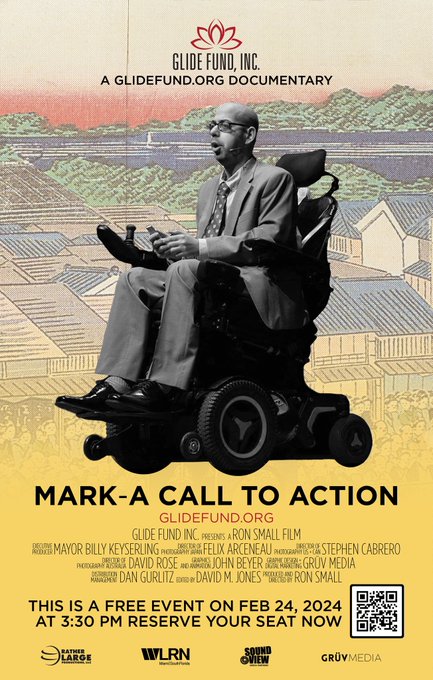
 MARK – A CALL TO ACTION GLOBAL RELEASE OCTOBER 8, 2024

Thanks to award-winning producer-director Ron Small and the Bookman Family, I appear as America's Universal design expert in a 90-minute documentary.

"Mark -- A Call To Action" releases globally October 8th via streaming, digital, satellite and other outlets.

From Filmmaker Small:

I'm happy to share the DVD menu, with some bonus features not seen in the documentary.

Pre-order the DVD on Amazon.

Visit https://amzn.to/3L8UMyZ All proceeds benefit the #GLIDEFUND of The Mark Bookman Foundation.


Saturday, January 13, 2024

TO FUND MY DISABILITY INCLUSION RESEARCH IN JAPAN

I HAVE GREATED A GO FUND ME ACCOUNT

I've spent more than three decades as an advocate for a better built environment for people with disabilities.

For several years, I have done more than $10,000 worth of pro bono work in the disability community.

I have an opportunity to join the family of the late Mark Bookman + Emmy-winning documentary maker Ron Small for a series of events previewing "Mark -- A Call to Action" in Tokyo.

The film portrays Mark's work as a global disability inclusion leader, based in Tokyo.

Bound for PBS, it also is a call to action for all architects, planners, engineers and more -- to create cities and places where all people with disabilities can access all housing, workplaces, schools, parks, arts, shopping, transit and more.

I am budgeting $4,000 for roundtrip airfare (economy, smallest seat), hotel (pod style, lowest cost), transportation (public transit where possible) and meals (low cost street food).

gofund.me/93c0532c


My amount of pro bono work means that for the first time in my life, I am seeking support to help cover the expense of my travel for research.

In addition to the premieres, I will be meeting with key leaders in the disability community in Japan.

Many feel Japan's commitment to Universal Design is creating inclusion for people with disabilities that rivals that opened by the landmark Americans with Disabilities Act.

My photography of innovative design and lifelong contacts made during my 10-day visit will inform dozens of articles and hundreds of social media posts.

gofund.me/93c0532c


I have written stories about best urban design practices to accommodate wheelchair users.

I have worked as a town planner to create better sidewalks, parks, transit and housing for people with disabilities.

I created a groundbreaking course on Universal Design at the highly rated University of Miami School of Architecture.

I make dozens of social media posts each day of the year -- sharing ideas for inclusion and equity in civic spaces.

Your support will allow me to continue to be a leader in planning and design of communities that are accessible to all.

gofund.me/93c0532c