Monday, March 16, 2015
HEIDI JOHNSON-WRIGHT ON THE ADA
STRONGTOWNS PODCAST LINK
A weekly conversation on the Strong Towns movement hosted by Charles Marohn. The podcast blends fiscal prudence with good urban design to highlight how America can financially strengthen its cities, towns and neighborhoods and, in the process, make them better places to live.
This week Chuck talks to Heidi Johnson-Wright, an ADA coordinator in Miami Dade County, about the Americans with Disabilities Act.
http://shoutengine.com/StrongTownsPodcast/heidi-johnson-wright-on-the-ada-7556
Tuesday, March 10, 2015
COMPLETE STREET WITH INCLUSIVE DESIGN
FROM STRONG TOWNS.ORG
By Heidi Johnson-Wright
http://www.strongtowns.org/journal/2015/3/2/complete-street-with-inclusive-design
By Heidi Johnson-Wright
““...(P)aralyzed limbs may not particularly limit a person’s
mobility as much as attitudinal and physical barriers. The question centers on
‘normality’. What, it is asked, is the normal way to be mobile over a distance
of a mile? Is it to walk, drive one’s own car, take a taxicab, ride a bicycle,
use a wheelchair, roller skate, or use a skate board, or some other means?””
— Prof. David Pfeiffer, Ph.D, internationally recognized
scholar in the field of disability studies, and polio survivor
Strong towns must also be inclusive towns, communities that
welcome everyone. Places where people of all abilities can live, work and get
around. Rights of way that are safe and accessible to folks with a range of
mobility needs.
What's it like to navigate streets as a wheelchair user?
What works? What doesn't?
I have been using a wheelchair as my principal means of
mobility for four decades, so I'm always seeking smooth, wide and level
surfaces. I want the safest and most comfortable path of travel possible. As
someone who has worked as an ADA compliance and public works professional, I'm
always analyzing sidewalks, streetscapes, curb and gutter, curb ramps and
crosswalks. My eyes are drawn to concrete work, to the types of pavers used, to
detectable warnings and the placement of bus shelters.
Sometimes, the smallest details make all the difference.
For me, the ideal accessible pedestrian path of travel is as
wide as the sidewalks lining the great avenues of New York City. Plenty of room
for walkers, wheelers, babies in strollers and then some. Lots of space for me
to safely pass around slow walkers when I'm in a hurry. It's disquieting when
someone half a block ahead sees me approaching and yanks their child out of my
oncoming path. Sometimes the sight of the poor kid flying through the air jolts
me so much, I whip around to see if I’ve unknowingly left a row of maimed
bodies behind in my wake.
Even pricey, well-made wheelchairs have limits to their
suspension. If I could, I'd pave the paths of the Earth with the rubber safety
surfaces used on playgrounds. Smooth, seamless and shock-absorbing makes me
smile. But given real-world requirements, smooth concrete with narrow stress
joints works for me. I also love wide, flat flagstones like the ones used
throughout Barcelona.
I dislike even the smoothest of pavers and despise
brickwork. What looks like tiny seams to walkers means major up-and-down
bumping for wheelers. Even a two-block trip with a Starbuck's latte in hand
results in coffee spills on my lap and a subsequent trip to the dry cleaners.
Longer trips over bumpy terrain mean repeated, sustained jarring that can
trigger serious pain for folks with arthritis and other disabilities. Don't
even get me started on tree well pavers or grates. Properly maintained Addapave
tree pits are a much better choice.
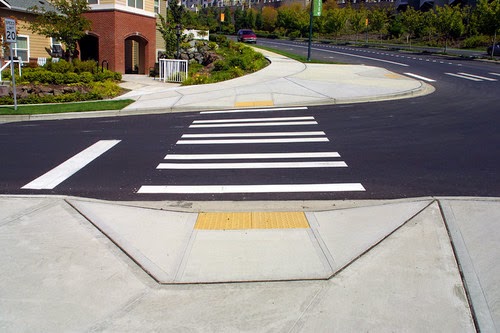
Let's talk about curb ramps. Their mundane appearance is
deceiving. My number one biggest complaint is the use of the cookie-cutter
clip-art curb ramp design where it doesn't belong. You know the one I mean.
It's the copy-and-paste design architects use in drawings where building
perimeters meet sidewalks and parking lots.
There are many different designs of curb ramps that can be
found in state DOT roadway design standards. Why? Because differences in
terrain and limitations of space require different ramp designs in order to be
compliant and safe. Level landings at top and bottom are essential. The top
landings in particular must be unobstructed. I can't count how many times I've
reached the top of a curb ramp only to nearly run into a pedestrian signal pole
or other irritating impediment. And please no meter boxes on the slope or storm
sewer grates at the bottom. Be sure there's a level, two-foot transition to the
gutter, or wheelers who forget to fasten their seat belts are likely to be
ejected.
Don't design curb ramps at the maximum 1:12 slope, but
rather 1:14. In fact, the feds say they're to be designed with the minimum
possible slope. And please: TWO curb ramps per corner instead of a single
diagonal ramp. Drivers can't tell where a wheeler is headed when he or she
comes off the diagonal into the street. And unless the corner, ramp,
intersection and crosswalk are all expertly designed in harmony, wheelers often
must go out into the active vehicular way in order to cross. Many times I've
had to cross using a diagonal ramp and felt air displacement from cars passing
along next to me.
And finally, nothing makes steam come out of my ears like
rolling along and being foiled by an easily preventable impediment or detour.
Pedestrian paths of travel are in flux and must always be monitored.
Coordination between local public works, transit, utilities, and state DOT is essential
to preventing obstructions caused by landscaping, light poles, street signs,
signal boxes, bus shelters, bus benches, newspaper boxes, bike racks, etc.
Just as bad are sidewalks suddenly blocked off with little
or no warning. In this case, I’m not talking about the simple sidewalk or lane
work, or an emergency fix of a broken water main. I mean many months of torn up
or obstructed rights of way due to long-term construction projects which provide
no alternative, accessible, safe pathway. What is a minor problem for a walker
who can easily re-route can prove to be an extremely inconvenient -- even
dangerous -- situation for someone in a wheelchair.
I’ve encountered this situation numerous times. Most
recently, I was attempting to get to a doctor’s office for a first-time
appointment. Due to limited parking options, I had to search for an on-street
space. I found spaces one block away, but the swale had obstructions that
blocked my van’s ramp from deploying. I had to settle for an on-street space
four blocks away.
After parking, I rolled along a couple blocks with bumpy
sidewalks and corners with dangerously steep curb ramps. But the worst was
saved for last. The final block to the doctor’s office was impassable due to
major construction that had closed off the sidewalk. My only real option was to
cross to the other side of the street, roll down the block, then cross back
over. Problem was, the street I had to cross was four lanes plus a turn lane. Drivers
fly down it like a highway. The closest signalized crossing was three blocks
the other way. A kind lady who saw my dilemma crossed with me at an
unsignalized but clearly marked pedestrian crosswalk. I am forever grateful,
knowing how wheelchair users have a lower profile than walkers. This makes us
like the amphibious targets in a real-life version of the classic video game,
Frogger.
Navigating a few blocks should not be so complicated and so
dangerous. Elected officials need initiatives such as New York City Mayor Bill
de Blasio’s Vision Zero push to eliminate traffic deaths. Planners, traffic
engineers, capital projects managers and public works departments that issue
rights of way permits need more common sense designs and policies.
All of these things should be formulated with input from the
disability community. Each county, city, town and village should have an
advisory committee comprised of local folks with disabilities. Those involved
in streetscape design should consult orientation and mobility trainers who work
with the visually impaired. People who are blind learn to navigate through the
world in specific ways. Design compatible with those methods often equals good,
sensible design.
The federal Proposed Guidelines for Pedestrian Facilities in
the Public Right-of-Way address access for blind pedestrians at street
crossings, wheelchair access to on-street parking, and various constraints
posed by space limitations, roadway design practices, slope, and terrain. These
guidelines -- which are expected to become mandatory and enforceable within a
year or two -- will cover pedestrian access to sidewalks and streets, including
crosswalks, curb ramps, street furnishings, pedestrian signals, parking, and
other components of public rights-of-way.
Now’s the time to focus on inclusive design.
http://www.strongtowns.org/journal/2015/3/2/complete-street-with-inclusive-design
Thursday, March 5, 2015
LITTLE HAVANA REVITALIZATION IS A GOOD THING
BUT ANY REZONING MUST PRESERVE CHARACTER AND AUTHENTICITY
Editor's Note: We have known Bill Fuller for more than a decade. He is by far the most responsible developer in Miami. This week, we received an open letter from him, urging Little Havana stakeholders to demand more from the City of Miami before it upzones a portion of the neighborhood. Bill is a visionary who understands preservation, walkability and authenticity. He urges City leaders to slow down and do more to protect the authenticity of Little Havana, so speculators do not build out-of-scale development. We note that some of our town planning friends support the pending upzoning as is. Our publishing of Bill Fuller's letter is not a blanket endorsement of everything he is suggesting, but the essence of his ideas is brilliant -- so we are publicizing his careful thoughts here:
Dear fellow stakeholders,
We are at a critical moment that will forever impact the
future of our beloved Little Havana.
Before we rush into upzoning and historic designation
recently initiated by the City of Miami, we should slow down and carefully
study all of the impacts on existing and future: residents, buildings,
businesses, scale and way of life.
Any designation of historic preservation or upzoning should
come in tandem with a “conservation district” overlay that will prescribe the
look and feel of future developments surrounding historic Little Havana.
As stakeholders who love everything Little Havana is and can
be, we must make sure that future developments are consistent with the context
and character of the neighborhood.
An overlay, that will preserve what is good and improve what
needs to be enhanced, must include strong guidelines that regulate:
· The
architectural style of new developments
· The size,
scale, style and character of public spaces
· Mixed-use
development that encourages ground floor retail with residences above
· Land use
in a way that preserves the walkable urban fabric that has served the
neighborhood for a century
· Out of
scale uses, such as superblock developments that vacate streets, or supersized
retail sites that that destroy the very urban flavor that has made the area so
desirable to investors
Little Havana is a neighborhood known throughout the world.
Locals and visitors alike adore it for arts, culture and
authenticity.
Adaptive re-use, properly-scaled infill development and
growth that accommodates a healthy range of household incomes are not only
welcomed, they should be encouraged by legislation that accommodates them
without ruining the neighborhood’s diverse flavor.
While there certainly is room for national retailers, they
should not be allowed to destroy Little Havana’s world-renown character by
building standard, off the shelf suburban buildings with seas of parking for
their drug stores, banks and restaurants.
The City of Miami’s landmark Miami 21 zoning code was passed
with the explicit intent of preserving all the wonderful human scale, unique
architecture and mainstreet business corridors that make its diverse
neighborhoods unique.
Sadly, since Miami 21, the City’s most famous street – Calle
Ocho – has been violated by a parade of suburban-style, boring buildings that
do nothing to preserve and enhance the beloved historic character of Little
Havana.
Soon, another development by a national company
headquartered hundreds of miles from Miami will build a suburban, drive-through
monstrosity on Calle Ocho. This bank, on the corner of SW 12th Avenue and
SW 8th street, will have nothing in common with the architectural style and
scale that made Calle Ocho the spiritual heart of the city.
These suburban developments destroy the very authenticity
that draws artists, entrepreneurs, innovators, startup restaurants and visitors
to Little Havana.
A well-crafted overlay must be created within Miami 21 and
it must have teeth enough to prevent the remaining good city blocks from being
destroyed.
Several established media sources have reported that a group
that operates car dealerships has assembled a lot of land in the part of Little
Havana that the City of Miami is fast tracking for an upzoning.
Car dealerships create jobs and commerce. They have their
place in greater Miami. No one is saying otherwise.
But can you imagine a huge car dealership -- with its sea of
asphalt to display cars and accommodate customers, street trees savagely clear
cut to open a view to the giant showroom and architecturally obscene compound
of repair bays, body shop and more – taking up several blocks in our
newly-minted residential historic district?
This is not a case of wanting to impose Coral Gables-like
zoning and beautification standards on the proud working class neighborhoods of
Little Havana.
This is simply a matter of drawing the line and demanding
that horrifically out of scale superblock developments do not destroy our
neighborhood.
City leaders would not dare allow a giant auto dealership,
or super warehouse club retailer in any of the dozens of historic and
significant neighborhoods that define our diverse Miami.
So why should Little Havana’s people get second- or
third-class treatment by imposing a monstrosity that would destroy livability
for several blocks in every direction?
But a car dealership or other quality-of-life crushing
superblock development will soon be a reality if we do not push the City of
Miami to place a use restriction on developments that endanger the vision have
for our preserved and re-energized neighborhood.
We support logical progress. But we must ask our city to
slow down, so we stakeholders can determine exactly what the strategy is being
considered. We must determine whether it is a holistic approach for the
neighborhood, or tweak to benefit only a few deep-pocketed investors.
I have not seen one developer or champion of the upzoning
come forward to explain its holistic benefit to our community.
I strongly support historic preservation. But I fear a
proposed historic district, without considering the entire neighborhood, is a
smoke screen created to placate skeptics while deflecting our attention from
the true core issue of a city rushing to upzone a neighborhood coveted by
speculators.
As stakeholders that have worked hard to preserve Little
Havana’s authenticity, I do not believe we can support a rush to upzone.
I urge you to stand united in our demand for a holistic
rezoning plan that preserves the character of the neighborhood we so dearly
love.
Sincerely,
Bill Fuller
Miami native, preservationist, investor in adaptive re-use
buildings and vigilant activist to preserve the heritage and authenticity of
Little Havana
Bill Fuller
Bill Fuller
Wednesday, March 4, 2015
THE STORY OF PEDRO THE CHIHUAHUA
A MORALITY TALE ON DURABLE MEDICAL EQUIPMENT
By Heidi Johnson-Wright
This is the story of Pedro, a Chihuahua. When Pedro was
born, his parents welcomed him into the world, although he was different than
his other siblings. You see, Pedro had no front legs, which is a pretty tough
predicament for a dog. His family took good care of him, but by the time he was
weaned, it was clear Pedro was going to need wheels.
So, his parents checked with their health insurer about
their durable medical coverage, which is a fancy phrase for “are they gonna pay
for a wheelchair or not?”
“Well,” said the client care representative, (which is a
fancy phrase for someone who works in a boiler room in Waterloo, Iowa and
follows a script on a computer screen) “you have coverage at 100 percent, but
only for a chair made from paper clips, Fun-Tak and old Tonka truck wheels.”
Pedro’s mom and dad were not pleased to hear this. Not at
all. So they began talking with rehab experts and disability ergonomic
specialists and doing research online. To be able to run and play like the
other dogs, Pedro needed a Canine Wheel-X 9000. This was no ordinary chair. It
was made from titanium, aircraft aluminum and water-resistant micro fiber --
and absolutely no Fun-Tak. His parents got a prescription and letter of medical
necessity from Pedro’s doctor, along with a cost estimate for the chair. They
submitted these, along with an appeal letter, to their insurance company. Weeks
later, they received a letter back.
The letter was lengthy and technical and somehow both overly
polite yet very dehumanizing, or in this case, de-canine-izing. The upshot was:
either accept the crappy uncomfortable, one-size-fits-most chair of paper clips
and Fun-Tak at no out-of-pocket cost, or spend a prince’s ransom of their own money
to get Pedro what he needed, i.e. the Canine Wheel-X 9000.
Being dedicated parents who loved Pedro very much, they
bought him the Canine Wheel-X 9000. Pedro was overjoyed, and once he received
his custom-fitted new chair that actually accommodated his needs, he went
tearing around the neighborhood. Soon, Pedro was chasing cats and retrieving
sticks. He was even able to use the fire hydrant on his own, whereas before, he
always fell over without someone to lean against.
But Pedro was no dim bulb. No sir-ee. He was well aware that
his family had been forced to move out of their custom Dogloo A-frame into a
cardboard box. And mom was stretching the daily meal of Science Diet by adding
sawdust. This was because his family had to scale back on costs because of what
they paid for his Canine Wheel-X 9000.
So, Pedro began collecting up the – how can we say this
politely? – “end products” of his digestive process. Day after day he saved
them and after he had a huge pile, put it all into a paper bag. He put it on a
little trailer and hauled it very, very far – all the way across town to the
home of the company president of his family’s health insurance provider. On the
president’s doorstep, when no one was looking, Pedro dumped the heavy paper
sack onto the stoop. He lit the sack with a match and then knocked on the door
by kicking it.
Then -- because he had the right wheelchair that
accommodated his needs -- he was able to run like hell. Once across the street,
Pedro watched as the door opened, a man came out and began stomping out the
flaming bag. Then the man examined his own shoes and cursed a blue streak.
It was a long trip back home, but Pedro ran briskly, his
little tail wagging the whole way.
Subscribe to:
Posts (Atom)